
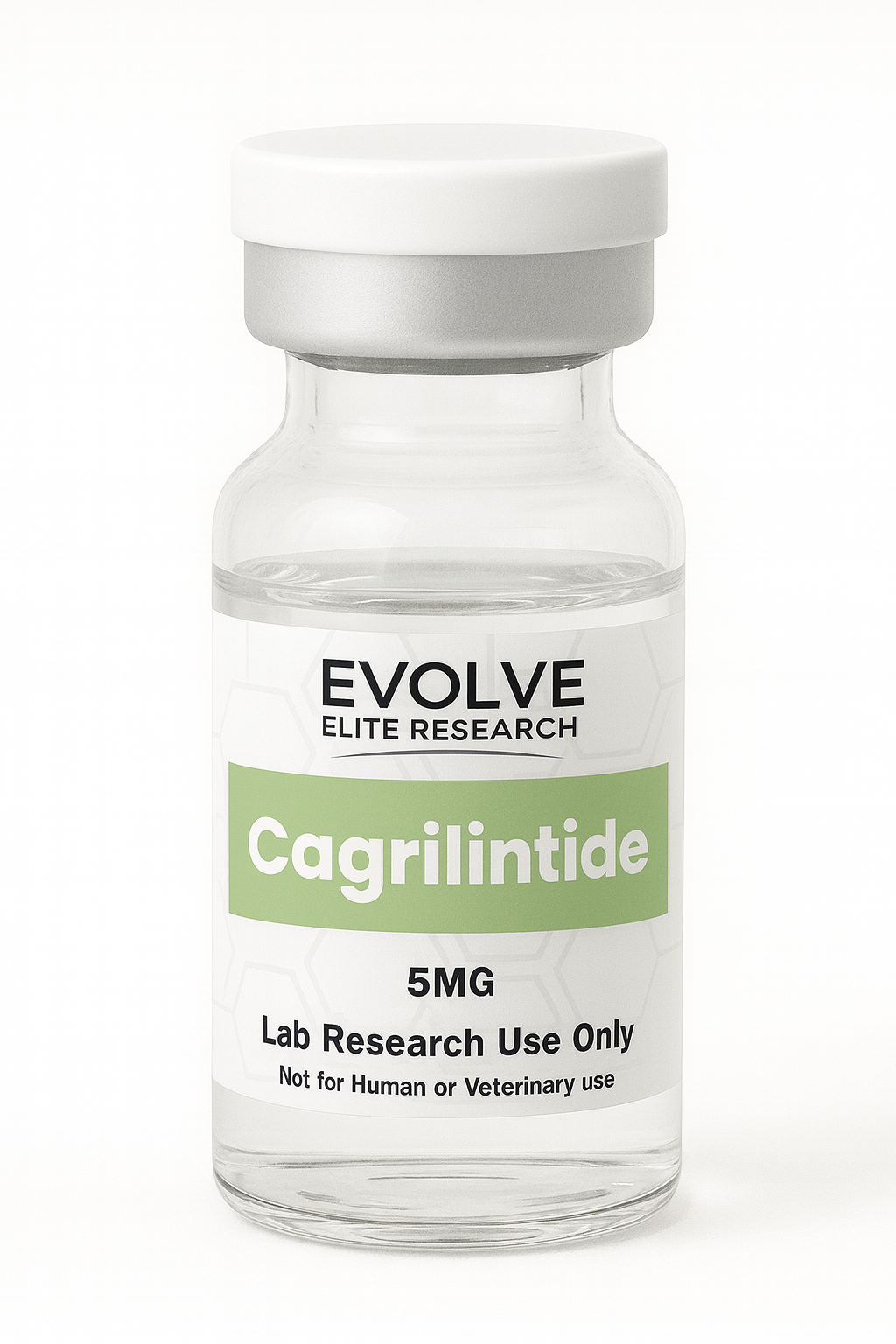
Cagrilintide 5MG
$40.00
Technical Specifications
- Product Name: Cagrilintide 5MG
- Scientific Name: Cagrilintide
- Common Name: Cagrilintide
- Peptide Classification: Synthetic Lipidated Amylin Analogue
- Primary Research Areas: Amylin-Receptor Pharmacology, Calcitonin-Receptor Signaling, RAMP Biology, cAMP Pathways, Receptor Trafficking, and Modified-Peptide Characterization
- Primary Receptor Systems: AMY1, AMY2, AMY3, and Calcitonin Receptor (CTR)
- Peptide Length: 37 Amino Acids
- Structural Feature: Lipid-Containing Side-Chain Modification
- Molecular Formula: C194H312N54O59S2
- Molecular Weight: Approximately 4,409 g/mol
- CAS Number: 1415456-99-3
- PubChem CID: 171397054
- Appearance: White to Off-White Lyophilized Research Material
- Research Quantity: 5MG
- Intended Use: Laboratory Research Only
For Laboratory Research Use Only.
Not intended for human or veterinary administration. The 5MG designation identifies nominal laboratory research quantity only and is not a recommended dose, schedule, formulation, reconstitution, or administration instruction.
In stock
🔬 For Laboratory Research Use Only.
Not for human consumption, medical, veterinary, or household use.
By purchasing you agree to our
Terms and
Refund Policy.
Structure–Activity Considerations
Cagrilintide’s receptor activity and extended experimental behavior depend on its complete engineered molecular structure.
Amino-acid substitutions may influence receptor recognition, aggregation tendency and susceptibility to enzymatic cleavage.
Lipidation may influence albumin binding, free concentration, chromatographic retention and duration of exposure.
Disulfide integrity may affect conformation and receptor interaction.
Terminal modifications may influence enzymatic stability and molecular identity.
Comparative structure–activity studies should control for both molar concentration and protein-containing assay conditions.
Evaluates how amino-acid substitutions influence stability and receptor pharmacology.
Investigates the contribution of lipidation to protein association and exposure duration.
Examines how reduction or rearrangement influences peptide conformation and activity.
Evaluates the influence of terminal chemistry on stability and receptor interaction.
Compares potency and efficacy across CTR, AMY1, AMY2 and AMY3 systems.
Compares receptor responses in protein-free and albumin-containing conditions.
Distinguishes engineered cagrilintide behavior from the endogenous peptide.
Supports comparison with pramlintide and other amylin-family research compounds.
Potential Laboratory Research Applications
Characterization of potency and efficacy at defined amylin-receptor subtypes.
Evaluation of cagrilintide activity at the calcitonin receptor without an associated RAMP.
Comparison of receptor pharmacology across RAMP1, RAMP2 and RAMP3 configurations.
Measurement of Gs-associated cyclic-AMP production following receptor activation.
Analysis of ligand-induced receptor trafficking and cell-surface availability.
Investigation of responsiveness following repeated or prolonged exposure.
Evaluation of neural activation, electrophysiology and immediate-early gene responses.
Investigation of area-postrema and nucleus-tractus-solitarius signaling systems.
Comparison of engineered and endogenous amylin-family peptide behavior.
Comparison with an earlier-generation amylin analogue.
Investigation of reversible association with albumin and related proteins.
Measurement of unbound peptide concentration in protein-containing systems.
Development of chromatographic methods for intact peptide and related species.
Confirmation of molecular identity, charge states and degradation-associated signals.
Monitoring of intact cagrilintide under defined buffer, temperature and time conditions.
Evaluation of molecular association under controlled concentration and handling conditions.
Why Researchers May Select Cagrilintide 5MG
Provides a standardized nominal quantity for focused laboratory allocation.
Suitable for preliminary receptor assays, analytical development and feasibility research.
Provides a defined amylin-family receptor research format.
Supports study of CTR, AMY1, AMY2 and AMY3 receptor systems.
Enables investigation of protein association, hydrophobicity and extended molecular exposure.
Supports comparison with native amylin and structurally distinct analogues.
May serve as a defined cagrilintide condition in receptor-comparison experiments.
Allows division of material among HPLC, LC-MS, stability and recovery workflows.
Supports receptor characterization across multiple experimental concentrations.
Supports comparison of immediate signaling and delayed receptor-regulation effects.
The compact format may reduce unused material during assay qualification.
Supports single-compound attribution without variables introduced by multi-component preparations.
Experimental Design Considerations
Define the Receptor Configuration
Identify whether the experiment involves CTR alone or a defined AMY1, AMY2 or AMY3 receptor complex.
Verify Receptor and RAMP Expression
Confirm receptor and accessory-protein abundance rather than relying solely on the name of the cell line.
Use a Concentration Series
Multiple concentrations are required to estimate potency, maximal efficacy and response shape.
Use Molar Concentrations
Molar normalization is generally preferable when comparing cagrilintide with peptides of different molecular weights.
Control Protein Content
Albumin and serum proteins may alter free peptide concentration and should remain consistent across conditions.
Measure Total and Free Peptide Where Relevant
Lipidated peptide research may require distinction between total exposure and unbound concentration.
Evaluate Receptor Desensitization
Acute and repeated-exposure experiments may produce different receptor responses.
Use Multiple Signaling Endpoints
cAMP, calcium, ERK and receptor-internalization measurements may provide complementary information.
Separate Direct and Indirect Effects
Distinguish direct receptor activation from secondary changes involving downstream signaling or endocrine mediators.
Monitor Peptide Integrity
HPLC or LC-MS may be used to verify that intact cagrilintide remains detectable during experimental incubation.
Assess Surface Recovery
Evaluate losses associated with plastic, glass, filters, tubing and sample-processing steps.
Control Agitation and Temperature
Physical handling and thermal exposure may influence aggregation and stability.
Assess Detection Interference
Cell-free controls should determine whether cagrilintide alters assay detection chemistry directly.
Predefine Combination Analysis
Select an additivity model before describing a cagrilintide combination response as synergistic.
Recommended Experimental Controls
Establishes baseline behavior without peptide exposure.
Determines whether the laboratory vehicle influences the endpoint.
Characterizes concentration-dependent receptor and functional responses.
Accounts for incubation duration and handling conditions.
Helps determine whether a response depends on calcitonin-family receptor expression.
Distinguishes calcitonin-receptor activity from RAMP-associated amylin-receptor activity.
Evaluates signaling through the CTR and RAMP1 receptor complex.
Evaluates signaling through the CTR and RAMP2 receptor complex.
Evaluates signaling through the CTR and RAMP3 receptor complex.
Provides comparison with the endogenous peptide-hormone framework.
Provides comparison with an earlier-generation amylin analogue.
Supports comparison of calcitonin-receptor pharmacology.
Supports investigation of receptor-dependent signaling.
Helps test dependence on Gs, adenylyl cyclase or downstream cAMP signaling.
Provides comparison with protein-containing conditions.
Controls protein concentration across experimental groups.
Distinguishes signaling responses from changes in cellular health.
Determines whether the peptide changes fluorescence, absorbance or luminescence directly.
Identifies background from buffers, solvents, columns and instruments.
Supports comparison of retention time, molecular mass and method performance.
Confirms whether intact cagrilintide remains detectable under assay conditions.
Measures peptide loss associated with containers, filters and sample preparation.
Analytical Characterization
Cagrilintide is a modified lipidated peptide requiring complementary analytical methods.
High-performance liquid chromatography may evaluate chromatographic composition, retention behavior and related molecular species.
Liquid chromatography–mass spectrometry may support confirmation of molecular species consistent with the expected intact mass.
Peptide mapping or tandem mass spectrometry may provide additional sequence and modification information.
Disulfide integrity may require specialized analytical evaluation.
Albumin association and hydrophobic surface binding may influence analytical recovery.
Aggregates and high-molecular-weight species may require size-exclusion chromatography, light scattering or other orthogonal methods.
One analytical result should not be expected to establish identity, quantity, purity, aggregation state, stability and biological activity simultaneously.
Total vial mass, cagrilintide-equivalent content, chromatographic composition, molecular identity, sequence integrity, lipid-side-chain identity, disulfide status, aggregation state and receptor bioactivity are separate material attributes.
HPLC Analysis of Cagrilintide
Reverse-phase high-performance liquid chromatography separates peptide-related species according to interaction with a hydrophobic stationary phase.
Cagrilintide’s lipid-containing side chain may increase retention relative to non-lipidated amylin-family peptides.
Retention may also be influenced by mobile-phase pH, ion-pairing reagent, column chemistry, gradient slope and temperature.
Gradient conditions should provide adequate separation of intact cagrilintide from truncated, oxidized, reduced, aggregated or otherwise modified forms.
Secondary peaks may represent degradation products, sequence variants, lipid-side-chain-related species or process-associated compounds.
Detection wavelength influences apparent response because peptide absorbance depends on backbone and side-chain composition.
Peak-area percentage does not independently establish total peptide-equivalent quantity.
Retention time alone does not establish identity and should be supported by mass spectrometry or another orthogonal method.
LC-MS and Molecular Identity
Liquid chromatography–mass spectrometry combines chromatographic separation with mass-to-charge analysis.
Cagrilintide may produce multiple protonation states because its peptide structure contains numerous ionizable groups.
The observed charge-state distribution may be deconvoluted to estimate intact neutral molecular mass.
Sodium, potassium, counterion or other adduct-associated signals may appear depending on sample preparation and source conditions.
The lipid-containing side chain may influence chromatographic behavior and electrospray-ionization response.
Source conditions that are too energetic may increase in-source fragmentation or reduce intact-peptide sensitivity.
Mass agreement supports expected molecular composition but does not independently establish sequence order, modification location, disulfide connectivity or receptor activity.
Tandem mass spectrometry and peptide mapping may provide additional structural evidence.
Receptor-Bioactivity Characterization
Chemical identity does not independently establish functional receptor activity.
Cagrilintide bioactivity may be evaluated through cAMP concentration-response assays in cells expressing defined receptor complexes.
Separate assays may be required for CTR, AMY1, AMY2 and AMY3 receptor configurations.
Potency and maximal efficacy should be reported independently.
Receptor density, RAMP abundance, incubation duration and protein content may influence observed activity.
A validated reference ligand may help normalize performance across separate experimental runs.
Functional activity should not be inferred solely from HPLC peak area or molecular-mass agreement.
Aggregation and Molecular-Association Research
Native amylin is well known for aggregation-related molecular behavior under selected conditions.
Cagrilintide was engineered to provide improved development characteristics, but aggregation and association should still be evaluated under the conditions of each laboratory protocol.
Concentration, pH, ionic strength, temperature, agitation, freeze–thaw exposure and container material may influence association.
Visible clarity does not establish the absence of soluble oligomers or subvisible particles.
Potential analytical methods include size-exclusion chromatography, dynamic light scattering, analytical ultracentrifugation and particle analysis.
Aggregation may affect receptor potency, analytical recovery and chromatographic interpretation.
Cagrilintide Stability Considerations
Cagrilintide stability may be influenced by temperature, moisture, oxygen, light, pH, enzymes, concentration and container composition.
Potential degradation pathways include hydrolysis, oxidation, deamidation, disulfide alteration, peptide-bond cleavage and aggregation.
The lipid-associated side chain may also undergo chemical or structural changes that alter molecular identity.
Lyophilization removes a substantial portion of water and may improve storage stability relative to continuous solution conditions.
Once placed into solution, degradation, aggregation and surface adsorption may occur more readily.
Albumin and other proteins may influence both stability and analytical recovery.
Stability should be demonstrated through analytical measurement rather than inferred from appearance alone.
Potential Degradation Pathways
Endopeptidases and exopeptidases may create shorter cagrilintide-related fragments.
Water-dependent reactions may affect peptide bonds or susceptible side chains.
Oxygen, light and reactive species may modify oxidation-sensitive molecular regions.
Selected residues may undergo time-, temperature- and pH-dependent change.
Reduction may disrupt native structural organization and receptor activity.
Incorrect connectivity may create conformationally distinct peptide forms.
Modification or loss of the lipid-associated structure may change identity and protein binding.
Concentration, agitation and solution conditions may promote molecular association.
The peptide may bind to glass, plastic, filters, tubing or other laboratory materials.
Albumin and other proteins may alter free concentration and analytical recovery.
Related molecular species may overlap with the intact cagrilintide peak.
Contamination may alter peptide integrity and invalidate experimental measurements.
Laboratory Storage
Lyophilized Cagrilintide 5MG should be maintained in a cool, dry and dark laboratory environment protected from unnecessary heat, moisture and direct light.
Longer-term storage should follow the product label, lot-specific documentation and validated institutional procedures.
Repeated temperature cycling should be minimized because it may introduce condensation and variable environmental exposure.
When condensation is possible, sealed material should be allowed to equilibrate under controlled laboratory conditions before opening.
Prepared research solutions are generally less stable than dry lyophilized material.
Solution stability depends on pH, buffer composition, protein content, temperature, concentration, container material and storage duration.
Storage information is provided solely for preservation of laboratory research material and is not a preparation, formulation, reconstitution, dosing, injection or administration protocol.
Laboratory Handling
Cagrilintide 5MG should be handled only by trained research personnel using procedures appropriate for modified and lipidated peptide materials.
Researchers should document the lot identifier, preparation date, solvent or buffer, calculated concentration, storage history and handling cycles.
Calibrated balances, pipettes and analytical instruments should be used when quantitative accuracy is required.
Small-volume transfer error, incomplete mixing, protein binding and surface adsorption may create differences between calculated and recovered concentrations.
Low-binding laboratory materials may be evaluated when adsorption has been demonstrated through recovery experiments.
Filtration methods should be tested for recovery before routine use.
Personal protective equipment, containment procedures and waste disposal should follow institutional requirements and the laboratory’s risk assessment.
Cagrilintide Compared With Related Research Compounds
Cagrilintide is an engineered lipidated analogue, while native amylin is the endogenous pancreatic peptide hormone.
Both are amylin analogues, but they differ in sequence engineering, lipidation and duration-oriented molecular design.
<
Cagrilintide vs. Semaglutide Research
Cagrilintide and semaglutide are structurally distinct modified peptides.
Cagrilintide is investigated as a long-acting amylin analogue with activity at amylin-receptor complexes and the calcitonin receptor.
Semaglutide is investigated primarily as a GLP-1 receptor agonist.
Their receptors belong to the broader class B GPCR family but differ in endogenous ligands, accessory proteins, tissue expression and physiological roles.
Comparative research should use independent receptor assays and molar normalization.
Combination research should include each peptide individually before combined-response interpretation.
Cagrilintide vs. Tirz Research
Cagrilintide and Tirz represent different peptide-hormone pathways.
Cagrilintide is associated with amylin receptors and the calcitonin receptor.
Tirz research involves a dual agonist designed to activate GIP and GLP-1 receptors.
The compounds differ in sequence, molecular weight, lipid modification, receptor pharmacology and analytical behavior.
Equal mass does not provide equal molar concentration or equal receptor activity.
Multi-pathway experiments should include each compound independently and use predefined interaction analysis.
Cagrilintide vs. Reta Research
Cagrilintide is an amylin and calcitonin-family receptor agonist.
Reta research involves a single modified peptide designed to activate GIP, GLP-1 and glucagon receptors.
The compounds therefore engage separate receptor systems despite overlapping interest in metabolic research.
Comparative studies should account for receptor potency, albumin association, free concentration and species-specific pharmacology.
A shared change in a functional endpoint does not establish a shared molecular mechanism.
Related Research Products and Resources
Scientific Research Resources
Frequently Asked Questions
What is Cagrilintide 5MG?
Cagril 5MG is a lyophilized laboratory research format containing a nominal 5MG quantity of cagrilintide.
What is cagrilintide?
Cagrilintide is an investigational, lipidated and long-acting synthetic amylin analogue.
What type of peptide is cagrilintide?
It is a modified peptide analogue associated with amylin and calcitonin-family receptor research.
What is the molecular formula of cagrilintide?
The commonly referenced molecular formula is C194H312N54O59S2.
What is the molecular weight of cagrilintide?
The referenced molecular weight is approximately 4,409 g/mol.
What is the PubChem CID for cagrilintide?
The PubChem Compound ID is 171397054.
What is the CAS number for cagrilintide?
The commonly referenced CAS number is 1415456-99-3.
What receptors does cagrilintide activate?
Cagrilintide is investigated as an agonist at amylin-receptor complexes and the calcitonin receptor.
What is an amylin receptor?
An amylin receptor is generally formed by association of the calcitonin receptor with a receptor activity-modifying protein.
What are RAMP proteins?
RAMPs are receptor activity-modifying proteins that influence receptor trafficking, ligand recognition and pharmacology.
What are AMY1, AMY2 and AMY3 receptors?
They are receptor complexes formed by the calcitonin receptor with RAMP1, RAMP2 and RAMP3, respectively.
Is cagrilintide a GLP-1 receptor agonist?
No. Cagrilintide is primarily associated with amylin and calcitonin-family receptor systems.
Why is cagrilintide lipidated?
Lipidation is investigated for its influence on protein association, physicochemical stability and duration of experimental exposure.
Can albumin affect cagrilintide receptor assays?
Yes. Albumin association may reduce the freely available peptide concentration relative to the total concentration.
What signaling pathway is commonly measured?
Amylin and calcitonin-family receptor activation is commonly evaluated through Gs, adenylyl cyclase and cAMP signaling.
Can cagrilintide be studied in neuronal models?
It may be evaluated in controlled receptor-expression, brainstem-signaling and neuronal-activation research systems.
What laboratory applications may involve cagrilintide?
Potential applications include receptor pharmacology, cAMP assays, neuronal signaling, albumin-binding research, HPLC, LC-MS and stability analysis.
Why should receptor and RAMP expression be confirmed?
The receptor configuration present in a cell system may substantially influence ligand potency and efficacy.
Why are molar concentrations useful?
Molar concentration controls molecule number when comparing peptides with different molecular weights.
Can HPLC confirm cagrilintide identity by itself?
HPLC can evaluate chromatographic behavior, but molecular identity should be supported by LC-MS or another orthogonal method.
Does molecular-mass agreement prove receptor activity?
No. Chemical identity and functional receptor bioactivity are separate material properties.
Why should aggregation be evaluated?
Molecular association may influence peptide recovery, receptor potency and analytical interpretation.
Does the 5MG label represent a recommended dose?
No. The 5MG designation identifies nominal laboratory research quantity only and does not represent a recommended amount, dosage, schedule, formulation, reconstitution or administration instruction.
Is Cagrilintide 5MG intended for human use?
No. It is strictly for controlled laboratory research and is not intended for human or veterinary administration.
Research-Use Notice
Cagrilintide 5MG is supplied exclusively as laboratory research material. It is not supplied or represented as a drug, finished pharmaceutical product, prescription medication, compounded preparation, food, dietary supplement, cosmetic or consumer product. It is not intended for human consumption, self-administration, medical use, veterinary use, household use, diagnostic use, topical application or therapeutic use.
Scientific information on this page is presented solely in the context of molecular identity, amylin and calcitonin-family receptor pharmacology, RAMP biology, cAMP signaling, receptor trafficking, neuronal research models, lipidation, albumin association, analytical characterization and experimental design.
References to endogenous amylin, pancreatic signaling, neuronal systems or downstream endocrine biology are provided only to describe areas of biochemical, cellular, receptor and preclinical investigation. They do not constitute medical claims, treatment recommendations, weight-management claims or representations regarding safety or effectiveness in humans.
Findings from receptor, cellular, ex vivo, tissue or animal research should not be interpreted as evidence of equivalent human outcomes, clinical benefit, dosing, bioavailability or suitability for administration.
No information on this page should be interpreted as instructions for preparation, formulation, reconstitution, dosing, administration, injection, self-experimentation, appetite modification, weight management, body-composition modification, diagnosis, prevention, mitigation or treatment of any disease or condition.
The 5MG designation identifies nominal laboratory research quantity only. It does not represent a recommended amount, dosage, schedule, formulation, reconstitution or administration instruction.
This material should be handled only by qualified research personnel in an appropriately controlled laboratory environment. Researchers are responsible for confirming molecular identity, reviewing available lot-specific analytical documentation, selecting suitable analytical methods, determining suitability for their experimental design and complying with all applicable institutional, local, state and federal requirements.
Related products
Research Compounds
Research Compounds
Research Compounds
Research Compounds
Research Compounds
Research Compounds
Research Compounds
Research Compounds