
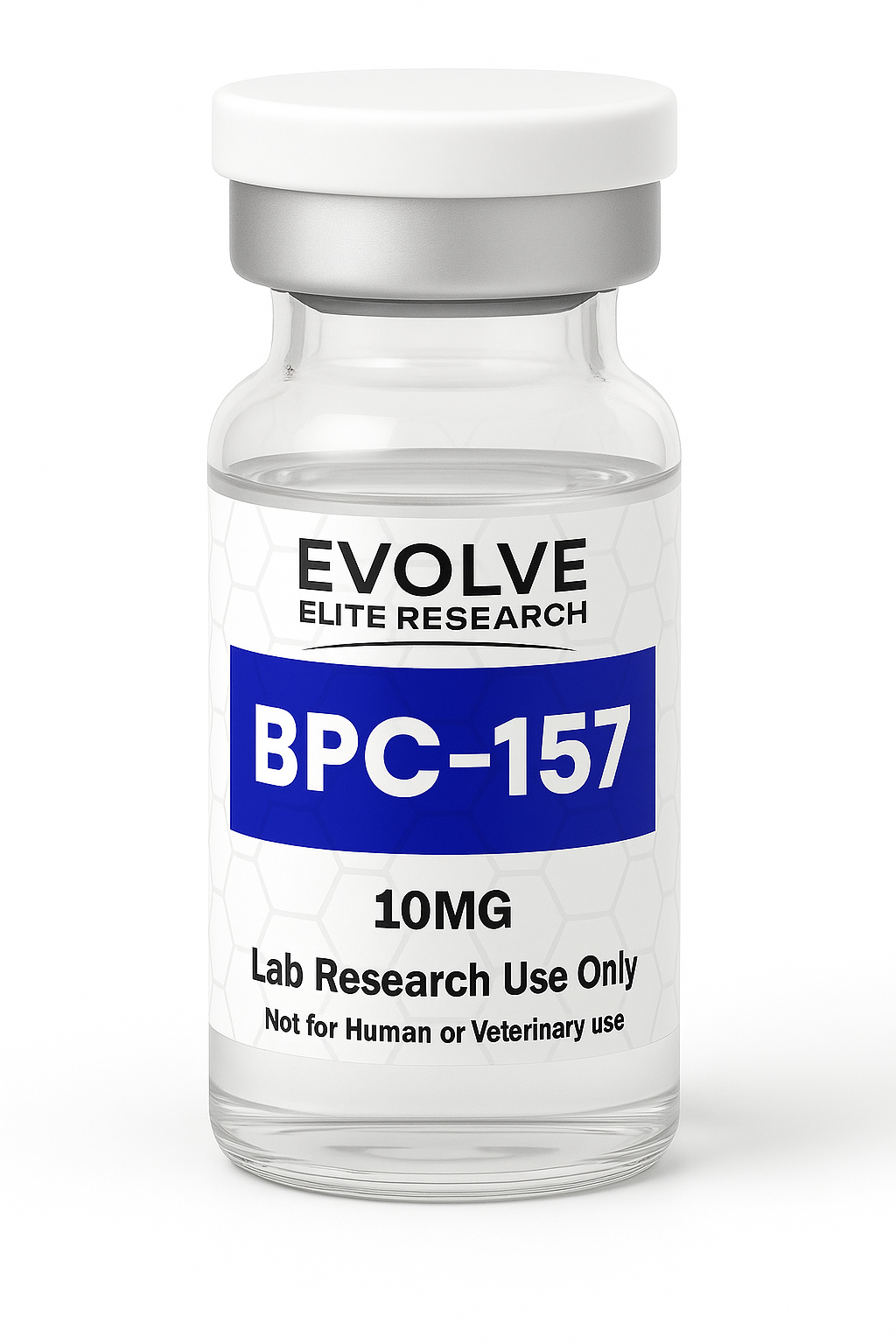
BPC-157 10MG
$32.00
Technical Specifications
- Product Name: BPC-157 10MG
- Scientific Name: Pentadecapeptide BPC-157
- Common Name: BPC-157
- Peptide Classification: Synthetic Pentadecapeptide
- Primary Research Areas: Cellular Migration, Endothelial Models, Extracellular-Matrix Systems, Nitric-Oxide-Associated Signaling, and Peptide Characterization
- Amino Acid Sequence: Gly-Glu-Pro-Pro-Pro-Gly-Lys-Pro-Ala-Asp-Asp-Ala-Gly-Leu-Val
- Molecular Formula: C62H98N16O22
- Molecular Weight: Approximately 1,419.5 g/mol
- CAS Number: 137525-51-0
- PubChem CID: 9941957
- Appearance: White to Off-White Lyophilized Powder
- Research Quantity: 10MG
- Intended Use: Laboratory Research Only
In stock
🔬 For Laboratory Research Use Only.
Not for human consumption, medical, veterinary, or household use.
By purchasing you agree to our
Terms and
Refund Policy.
Expanded BPC-157 research quantity for replicate studies, analytical allocation and controlled comparative workflows
Defined synthetic pentadecapeptide represented by the sequence GEPPPGKPADDAGLV
Supported by PubChem and PubMed research-reference links
Prepared and shipped from our Texas facility with fast U.S. order processing
BPC-157 10MG is a defined lyophilized research format containing a synthetic 15-amino-acid pentadecapeptide. It is supplied for controlled laboratory and preclinical investigations involving peptide characterization, cellular migration, endothelial responses, cytoskeletal organization, extracellular-matrix systems, gastrointestinal models and nitric-oxide-associated signaling.
BPC-157 10MG Research Summary
BPC-157 is a synthetic linear pentadecapeptide composed of 15 amino-acid residues. Its commonly reported sequence is Gly-Glu-Pro-Pro-Pro-Gly-Lys-Pro-Ala-Asp-Asp-Ala-Gly-Leu-Val, abbreviated GEPPPGKPADDAGLV.
Scientific literature has evaluated BPC-157 primarily in biochemical, cellular and animal models rather than through established human clinical applications. Investigated systems include cellular migration, endothelial-cell behavior, fibroblast models, cytoskeletal organization, extracellular-matrix interactions, gastrointestinal tissues and nitric-oxide-associated pathways.
No single universally established receptor has been demonstrated to explain every experimental observation associated with BPC-157. Mechanistic studies should therefore distinguish direct molecular interaction from downstream pathway association and functional experimental outcomes.
Relevant endpoints may include migration rate, cell viability, cytoskeletal morphology, endothelial network organization, barrier measurements, protein phosphorylation, gene expression, matrix-associated protein abundance and peptide stability.
The defined 10MG format may support replicate experiments, concentration-response testing, time-course studies, comparative peptide research and allocation of material for independent analytical characterization.
BPC-157 10MG is supplied exclusively for controlled laboratory research. It is not represented as a finished pharmaceutical product and is not intended for human or veterinary administration.
BPC-157 10MG Technical Specifications
BPC-157 10MG
BPC-157
Bepecin
Synthetic pentadecapeptide
10MG per vial
Lyophilized research material
15 amino-acid residues
GEPPPGKPADDAGLV
Gly-Glu-Pro-Pro-Pro-Gly-Lys-Pro-Ala-Asp-Asp-Ala-Gly-Leu-Val
C62H98N16O22
Approximately 1,419.5 g/mol
137525-51-0
9941957
Linear, non-cyclic peptide
Glycine
Valine
Peptide characterization, cellular migration, endothelial, matrix and gastrointestinal models
HPLC, LC-MS, sequence analysis and stability research
Dry lyophilized peptide
Laboratory research only
Molecular calculations should identify whether the tested material is represented as BPC-157 free base, an acetate-associated form, a trifluoroacetate-associated form or another documented counterion form. Free-peptide mass and total salt-associated material mass should not automatically be treated as identical.
BPC-157 Sequence and Molecular Characteristics
Gly-Glu-Pro-Pro-Pro-Gly-Lys-Pro-Ala-Asp-Asp-Ala-Gly-Leu-Val
Abbreviated Sequence:
GEPPPGKPADDAGLV
BPC-157 is an unbranched linear peptide containing 15 amino-acid residues joined through conventional peptide bonds. The sequence includes four proline residues, three glycine residues, two aspartic-acid residues, two alanine residues and one residue each of glutamic acid, lysine, leucine and valine.
Proline-rich regions may restrict local backbone geometry, while glycine residues provide regions of increased conformational flexibility. Glutamic acid and aspartic acid contribute acidic side chains, lysine contributes a basic side chain, and alanine, leucine and valine contribute nonpolar characteristics.
BPC-157 contains no cysteine residues and therefore does not form a conventional intramolecular disulfide bridge. Sequence truncation, residue substitution, terminal modification or counterion variation creates a chemically distinct research material and should be documented when comparing sources or experimental conditions.
BPC-157 contains 15 residues in a continuous, non-cyclic peptide chain.
Four proline residues contribute conformational constraints within the peptide backbone.
Three glycine residues provide regions of increased backbone flexibility.
Glutamic acid, aspartic acid and lysine contribute pH-dependent charge characteristics.
The sequence contains no cysteine and does not form a conventional intramolecular disulfide bond.
Truncation, substitution or terminal modification produces a distinct peptide form.
BPC-157 Scientific Background and Research Areas
BPC-157 is described in scientific literature as a synthetic peptide associated with gastric-peptide-related research. Most published investigations have involved biochemical, cellular or animal models, and those findings do not establish safety, efficacy or suitability for human use.
Reported observations span several interconnected systems. Because broad biological effects do not establish one direct receptor or universal mechanism, well-controlled studies should use pathway-specific measurements, inhibitors, receptor-negative systems, genetic methods or direct interaction assays where appropriate.
Evaluation of migration velocity, directionality, persistence and total distance using scratch, transwell, Boyden-chamber or live-cell tracking models.
Investigation of actin organization, cellular polarity, focal-adhesion-associated proteins, integrin-related behavior and attachment strength.
Analysis of endothelial migration, permeability, barrier resistance, network organization and defined endothelial-signaling endpoints.
Evaluation of fibroblast migration, morphology, matrix-protein abundance and extracellular-matrix organization in controlled laboratory systems.
Investigation of epithelial integrity, barrier measurements, junction-associated proteins and tissue morphology in gastrointestinal laboratory models.
Measurement of nitric-oxide production, nitric-oxide-synthase-associated pathways, cyclic-GMP signaling and related biochemical endpoints.
Evaluation of cytokines, transcription factors, oxidative markers, reactive-species measurements and cellular stress responses.
Analysis of transcriptional responses, protein abundance, phosphorylation and functional outcomes across defined observation periods.
A change in migration, phosphorylation, gene expression, nitric-oxide-associated signaling or matrix production does not independently establish direct BPC-157 binding to one receptor, enzyme or pathway. Direct interaction should be distinguished from downstream changes caused by altered cell state, viability, adhesion or secreted factors.
Experimental Design and Recommended Controls
BPC-157 studies should define the primary objective before selecting concentrations, observation periods and analytical endpoints. A single concentration or one endpoint rarely characterizes the full experimental response.
Establish baseline behavior and determine whether the preparation medium affects the measured endpoint.
Characterizes concentration-dependent responses instead of relying on one exposure condition.
Helps distinguish early signaling responses from delayed transcriptional or functional changes.
Separate functional observations from altered cell survival, metabolic activity or cell division.
May help determine whether an observation depends on sequence order or the intact 15-residue peptide.
Inhibitors, receptor-negative systems or genetic methods may strengthen mechanistic conclusions.
Determines whether BPC-157 directly changes fluorescence, absorbance, luminescence or colorimetric chemistry.
HPLC or LC-MS may evaluate intact peptide while recovery studies assess loss to containers, filters or tubing.
Functional, biochemical, imaging and analytical measurements provide stronger evidence than one assay alone.
Scratch closure does not independently demonstrate increased cellular migration because proliferation, viability and adhesion can also reduce the open area. Direct cell tracking and proliferation controls may improve interpretation.
BPC-157 Analytical Characterization
Molecular identity, sequence integrity, chromatographic composition, peptide-equivalent content, counterion form, recovered concentration and functional activity are separate analytical properties. Multiple complementary methods may therefore be required.
Reverse-phase HPLC may evaluate retention behavior, chromatographic composition and detectable peptide-related species under a defined method.
LC-MS may support molecular-identity analysis through observed mass-to-charge signals, charge-state deconvolution and detection of related molecular species.
Tandem mass spectrometry or another validated method may provide additional evidence supporting the expected amino-acid order.
Counterion, residual-solvent and water measurements may be relevant when total material mass is compared with peptide-equivalent content.
Repeated HPLC or LC-MS analysis may determine whether intact BPC-157 remains detectable under the selected study conditions.
Containers, filters, tubing and biological matrices may affect recovered peptide concentration through adsorption or binding.
Total vial mass, chromatographic peak-area percentage, molecular identity, sequence integrity, peptide-equivalent content, counterion form and biological activity should not be treated as interchangeable measurements.
Stability, Storage and Laboratory Handling
Peptide stability may be influenced by temperature, moisture, light, oxygen, pH, enzymes, concentration, container material, matrix composition and storage duration. Potential changes include hydrolysis, oxidation, deamidation, isomerization, peptide-bond cleavage, terminal truncation and surface adsorption.
Lyophilized BPC-157 10MG should be maintained in a cool, dry and dark laboratory environment protected from excessive heat, moisture and direct light. Longer-term storage should follow applicable lot documentation and validated institutional procedures.
Repeated temperature cycling should be minimized. Prepared research solutions may be less stable than dry lyophilized material, and their stability depends on pH, buffer composition, protein content, temperature, concentration, container material and storage duration.
Researchers should document the lot identifier, preparation date, solvent or buffer, calculated concentration, storage history and number of handling cycles. Calibrated quantitative equipment should be used when accuracy is required, and laboratory PPE, containment and disposal procedures should follow institutional requirements.
Protect dry material from excessive heat, moisture and repeated temperature cycling.
Limit unnecessary exposure when oxidative or photochemical changes are possible.
Evaluate solution stability and recovery under the actual buffer and matrix conditions used.
Containers, filters and tubing may influence recovered concentration and should be evaluated when relevant.
Solution appearance does not establish molecular integrity; suitable analytical methods should be used.
Record preparation, storage, handling and analytical details required for reproducibility.
Storage and handling information is provided solely to preserve research material. It is not a reconstitution, dosing, administration or personal-use protocol.
Why Researchers May Select BPC-157 10MG
Provides a documented 10MG quantity for controlled laboratory allocation.
Supports repeated experiments, technical replicates and independent analytical testing.
Provides material for evaluation across multiple experimental concentrations.
Supports early, intermediate and delayed observation periods.
Enables focused BPC-157 investigation without additional blend components.
Allows separation of material for HPLC, LC-MS, recovery and stability workflows.
Related BPC-157 Research Products and Resources
BPC-157 Scientific Research Resources
The following external resources are provided for compound identification, literature discovery and verification of the current research record. External database content is maintained by the respective publishers.
BPC-157 10MG Frequently Asked Questions
What is BPC-157 10MG?
BPC-157 10MG is a lyophilized laboratory research format containing 10MG of the synthetic pentadecapeptide BPC-157.
What does pentadecapeptide mean?
Pentadecapeptide means that the molecule contains 15 amino-acid residues.
What is the amino-acid sequence of BPC-157?
The sequence is Gly-Glu-Pro-Pro-Pro-Gly-Lys-Pro-Ala-Asp-Asp-Ala-Gly-Leu-Val, abbreviated GEPPPGKPADDAGLV.
Is BPC-157 linear or cyclic?
BPC-157 is represented as a linear, non-cyclic peptide.
Does BPC-157 contain a disulfide bridge?
No. Its sequence contains no cysteine residues and therefore does not form a conventional intramolecular disulfide bridge.
What is the molecular formula of BPC-157?
PubChem represents the referenced free-base molecular formula as C62H98N16O22.
What is the molecular weight of BPC-157?
The molecular weight is approximately 1,419.5 g/mol for the referenced free-base molecular record.
What are the CAS number and PubChem CID for BPC-157?
The commonly listed CAS number is 137525-51-0, and the PubChem Compound ID is 9941957.
Does BPC-157 have one confirmed receptor?
No single universally established direct receptor currently explains every reported preclinical observation involving BPC-157.
What research areas involve BPC-157?
Research areas include peptide characterization, cellular migration, endothelial systems, cytoskeletal biology, fibroblast and matrix models, gastrointestinal tissues and nitric-oxide-associated pathways.
Can BPC-157 be evaluated in migration assays?
It may be evaluated in controlled scratch, transwell, Boyden-chamber and live-cell tracking models.
Does scratch closure prove increased migration?
No. Cell proliferation, viability and adhesion can also influence closure of the experimental gap.
Can BPC-157 be evaluated in endothelial models?
It may be evaluated in controlled endothelial migration, barrier and network-organization systems. These simplified models do not independently demonstrate formation of functional blood vessels.
Can BPC-157 be evaluated in gastrointestinal models?
It has been investigated in preclinical gastric, intestinal and epithelial-response systems.
How does BPC-157 differ from TB-500?
BPC-157 is a 15-residue pentadecapeptide, while TB-500 is an acetylated seven-residue thymosin-beta-4-related fragment.
How does standalone BPC-157 differ from a BPC-157/TB-500 blend?
Standalone BPC-157 contains one peptide, while the blend introduces TB-500 and additional combination variables. Standalone material supports clearer component attribution.
Can HPLC confirm BPC-157 identity by itself?
HPLC can evaluate chromatographic behavior, but molecular identity should be supported through LC-MS or another suitable orthogonal method.
Why is BPC-157 supplied in lyophilized form?
Lyophilization creates a dry research format commonly used for shipment, inventory management and controlled analytical preparation.
Does preclinical research establish human efficacy?
No. Findings from biochemical, cellular and animal models do not establish safety or efficacy in humans.
Does the 10MG designation represent a recommended dose?
No. The 10MG designation identifies nominal laboratory research quantity only and does not represent a recommended amount, dosage, schedule or administration instruction.
Is BPC-157 10MG intended for human use?
No. It is supplied strictly for controlled laboratory research and is not intended for human or veterinary administration.
Research-Use Notice
BPC-157 10MG is supplied exclusively as laboratory research material. It is not a drug, finished pharmaceutical product, food, dietary supplement, cosmetic or consumer product. It is not intended for human consumption, self-administration, medical use, veterinary use, household use, diagnostic use, topical application or therapeutic use.
This research material is not represented as an approved pharmaceutical product, a generic equivalent, a compounded medication or a material suitable for personal use.
References to cellular migration, endothelial cells, fibroblasts, extracellular matrices, gastrointestinal tissues, nitric-oxide pathways, focal adhesions, cellular signaling or published scientific findings are provided solely to describe areas of laboratory and preclinical investigation.
These references do not constitute medical claims, treatment recommendations or representations regarding the safety or effectiveness of this research material.
Most published BPC-157 research has involved biochemical, cellular or animal models. Findings from those models do not establish safety, efficacy, dosing, bioavailability or suitability for administration to humans or animals.
No information on this page should be interpreted as instructions for reconstitution, dosing, administration, injection, self-experimentation, diagnosis, prevention, mitigation or treatment of any disease or condition.
This material should be handled only by qualified research personnel in an appropriately controlled laboratory environment. Researchers are responsible for confirming molecular identity, selecting suitable analytical methods, determining suitability for their experimental design and complying with all applicable institutional, local, state and federal requirements.
Related products
Research Compounds
Research Compounds
Research Compounds
Research Compounds
Research Compounds
Research Compounds
Research Compounds
Research Compounds