
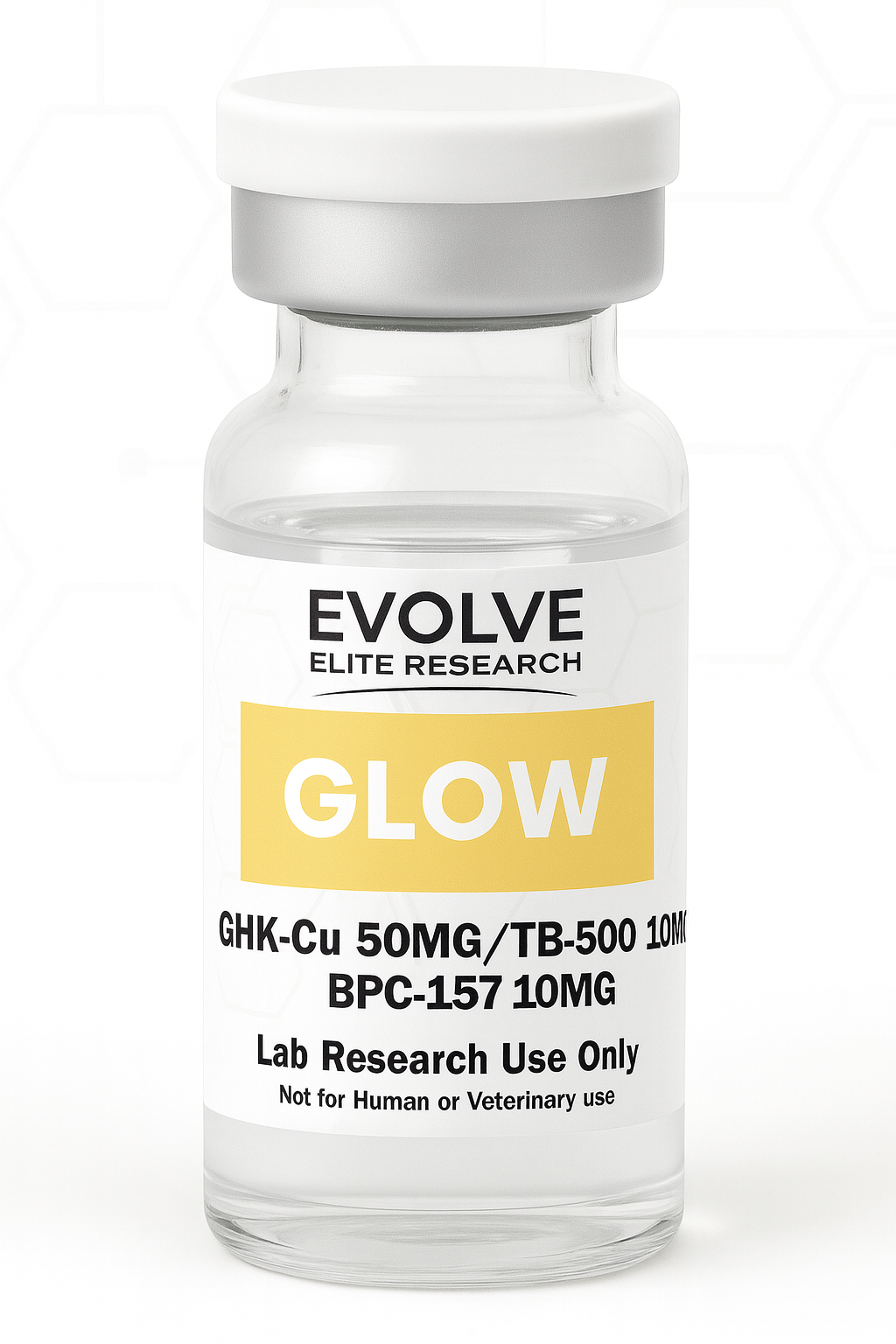
GLOW 70MG
$73.00
Technical Specifications
- Product Name: GLOW 70MG
- Scientific Description: Defined Three-Component Peptide Research Blend
- Common Name: GLOW
- Research Classification: Synthetic Multi-Peptide Research Blend
- Research Components: GHK-Cu, BPC-157, and TB-500 (Ac-LKKTETQ)
- Blend Composition: 50MG GHK-Cu / 10MG BPC-157 / 10MG TB-500
- Mass Ratio: 5:1:1
- Primary Research Areas: Peptide–Metal Biology, Cellular Migration, Cytoskeletal Systems, Fibroblast-Associated Models, and Multi-Analyte Characterization
- Total Research Quantity: 70MG
- Appearance: Blue Lyophilized Research Material
- Intended Use: Laboratory Research Only
For Laboratory Research Use Only.
Not intended for human or veterinary administration, topical application, cosmetic use, or therapeutic use. The 70MG total and individual 50MG / 10MG / 10MG component quantities identify laboratory research quantities only and are not recommended doses, schedules, formulations, reconstitution instructions, or administration instructions.
In stock
🔬 For Laboratory Research Use Only.
Not for human consumption, medical, veterinary, or household use.
By purchasing you agree to our
Terms and
Refund Policy.
GHK-Cu 50MG, BPC-157 10MG and TB-500 10MG in one laboratory research format
Designed for peptide–metal, cellular, cytoskeletal and multi-analyte research
Supports individual-component, combined-response and comparative blend research
Prepared and shipped from our Texas facility with fast U.S. order processing
A defined three-component lyophilized research blend containing GHK-Cu 50MG, BPC-157 10MG and TB-500 10MG for controlled laboratory investigations involving peptide–metal interactions, cellular migration, cytoskeletal systems, fibroblast-associated models and multi-component analytical characterization.
GLOW 70MG Research Summary
GLOW 70MG is the Evolve Elite Research designation for a defined three-component peptide blend containing GHK-Cu, BPC-157 and TB-500.
Each vial contains 50MG of GHK-Cu, 10MG of BPC-157 and 10MG of TB-500, providing a total nominal research quantity of 70MG.
GHK-Cu is a copper-associated tripeptide complex formed through interaction between the glycyl-L-histidyl-L-lysine peptide and copper ions. It is investigated in peptide–metal coordination, fibroblast-associated systems, matrix-related gene expression, metalloproteinase research and copper-dependent peptide biology.
BPC-157 is a synthetic 15-amino-acid peptide commonly represented by the sequence GEPPPGKPADDAGLV. It is investigated in experimental models involving cellular migration, endothelial systems, cytoskeletal organization, epithelial models and stress-response pathways.
The TB-500 component used in this blend is the short N-terminally acetylated peptide Ac-LKKTETQ. It should not be confused with full-length thymosin beta-4, which is a separate 43-amino-acid protein-derived peptide with different molecular characteristics.
TB-500 research commonly focuses on cellular migration, actin-associated biology, cytoskeletal organization and peptide-fragment research.
GLOW is not a new single molecular entity. It is a physical mixture of three chemically distinct research components, each possessing its own molecular mass, chromatographic behavior, stability profile and potential interaction with experimental systems.
The blend may be used in studies comparing the combined preparation with its individual components, matched-component controls or alternative peptide combinations.
GLOW 70MG is supplied strictly for controlled laboratory research. It is not intended for human or veterinary administration, cosmetic application, diagnostic use or therapeutic use.
Technical Specifications
GLOW 70MG
Defined three-component peptide blend
70MG per vial
50MG
10MG
10MG
Lyophilized research material
Three chemically distinct research compounds
GHK coordinated with copper
GEPPPGKPADDAGLV
Ac-LKKTETQ
Approximately 403.9 Da
Approximately 1,419.5 Da
Approximately 889 Da
Peptide–metal biology, cellular migration, cytoskeletal systems, fibroblast-associated models and blend characterization
HPLC, LC-MS and component-stability research
Dry lyophilized blend
Laboratory research only
GLOW contains three compounds with different molecular weights. The blend does not have one unified molecular weight or molecular formula. Quantitative molar calculations must be performed separately for GHK-Cu, BPC-157 and TB-500 using the documented quantity and molecular form of each component.
Defined Blend Composition
Copper-associated tripeptide complex investigated in peptide–metal coordination, fibroblast-associated systems, matrix-related gene expression and analytical characterization.
Synthetic 15-amino-acid peptide investigated in cellular migration, endothelial models, cytoskeletal biology and controlled cellular systems.
Short acetylated peptide Ac-LKKTETQ investigated in actin-associated biology, cell migration and cytoskeletal organization.
The components are present in a 5:1:1 mass ratio. Because their molecular weights differ, this mass ratio is not equivalent to a 5:1:1 molar ratio.
GHK-Cu represents the largest mass contribution, while BPC-157 and TB-500 are present at equal nominal mass quantities.
Experimental interpretation should distinguish between total blend mass, individual-component mass and calculated molar concentration.
Researchers seeking to attribute an observed response to one component should use matched individual-component controls rather than relying on the blend alone.
Molecular Characteristics of the Blend
GLOW contains three structurally different research compounds rather than one covalently linked molecule.
GHK-Cu is a metal-associated tripeptide complex. BPC-157 is an unbranched 15-amino-acid synthetic peptide. TB-500 is a short N-terminally acetylated seven-residue peptide.
The components differ substantially in size, charge, hydrophobicity, metal-binding behavior and susceptibility to chemical or enzymatic degradation.
These differences may influence chromatographic separation, ionization efficiency, surface adsorption, solubility and recovery from complex matrices.
The copper-associated component may also interact with buffers, chelators, reducing agents, proteins and laboratory surfaces differently from the non-metal-containing peptides.
Consequently, analytical methods optimized for one component may not provide equivalent sensitivity or recovery for the others.
Each component retains its own chemical identity within the physical blend.
Each component requires separate mass-to-mole calculations.
GHK-Cu introduces copper-coordination chemistry not shared by BPC-157 or TB-500.
The blend contains a tripeptide complex, a 15-residue peptide and a seven-residue acetylated peptide.
Each component may degrade or interact with matrices at a different rate.
Reliable analysis may require separate detection or confirmation of all three components.
Scientific Background
Complex cellular models may involve coordinated activity among matrix-associated proteins, fibroblasts, endothelial cells, signaling networks, cytoskeletal structures and soluble regulatory molecules.
No single pathway independently explains cell migration, matrix-associated changes, endothelial behavior or cytoskeletal responses.
GHK-Cu, BPC-157 and TB-500 are investigated in different but potentially overlapping experimental contexts.
GHK-Cu is frequently studied in relation to copper-dependent peptide signaling, fibroblast-associated systems, matrix-related gene expression, matrix metalloproteinases and transcriptional responses.
BPC-157 is investigated in cellular and animal models involving endothelial responses, cytoskeletal organization, migration and epithelial systems.
TB-500 is studied as a short thymosin-beta-4-related research peptide associated with actin biology and cell migration.
Combining these materials may support multi-component research, but the existence of complementary literature does not establish that the blend will produce additive or synergistic effects in every model.
Combined-response claims require direct testing against each individual component, appropriate paired combinations and a defined null model of additivity.
GHK-Cu Research Component
GHK is the naturally occurring tripeptide glycyl-L-histidyl-L-lysine. Its histidine-containing structure can coordinate copper ions to form the complex commonly described as GHK-Cu.
Copper coordination changes the physicochemical properties of the peptide and is central to many experimental investigations involving GHK-Cu.
GHK-Cu has been studied in fibroblast models, matrix-associated gene expression, glycosaminoglycan research, antioxidant-response systems and peptide–metal biology.
Research may evaluate matrix-metalloproteinase activity and tissue inhibitors of metalloproteinases as separate matrix-associated experimental endpoints.
GHK-Cu may also be examined in copper-transport and peptide–metal binding studies.
Free copper, uncomplexed GHK and intact GHK-Cu should not automatically be treated as analytically or biologically equivalent.
Chelators, reducing agents and competing metal-binding molecules may alter copper coordination and therefore affect experimental results.
Copper-Coordination Research
Copper is a redox-active transition metal used by multiple enzymes and biological systems.
In GHK-Cu, copper is coordinated by donor atoms within the peptide structure. The precise distribution of molecular species can depend on pH, concentration, ionic strength and competing ligands.
Buffers containing strong metal-binding components may compete with GHK and alter complex integrity.
EDTA and related chelating agents may interfere with experiments intended to preserve or measure the intact copper complex.
Researchers may use ultraviolet-visible spectroscopy, mass spectrometry, chromatography or other coordination-sensitive methods to study the metal-associated component.
Copper-dependent oxidation should be considered separately from intended peptide-associated signaling.
Buffer composition, pH, chelators and competing proteins may influence the molecular form and freely available copper associated with GHK-Cu.
BPC-157 Research Component
BPC-157 is a synthetic 15-amino-acid peptide commonly represented by the sequence GEPPPGKPADDAGLV.
It is investigated primarily in preclinical and laboratory research models.
Experimental research has examined BPC-157 in relation to endothelial-cell models, cellular migration, cytoskeletal organization, nitric-oxide-associated signaling and epithelial systems.
BPC-157 does not have a universally accepted single molecular receptor that accounts for all reported observations.
Mechanistic research should therefore evaluate defined pathways rather than treating broad biological descriptions as established direct mechanisms.
Potential experimental endpoints include migration rate, scratch-closure measurements, barrier resistance, permeability, phosphorylation of signaling proteins, cytoskeletal morphology and gene expression.
Cell viability and proliferation should be evaluated separately because increased cell number can influence apparent migration or closure measurements.
TB-500 Research Component
The TB-500 component in GLOW is the short synthetic peptide Ac-LKKTETQ.
Its molecular formula is approximately C38H68N10O14, and its molecular weight is approximately 889 Da.
TB-500 is related to an N-terminal region of thymosin beta-4 but is not equivalent to full-length thymosin beta-4.
Full-length thymosin beta-4 contains 43 amino-acid residues and possesses different molecular and functional characteristics.
Research involving TB-500 may examine cell migration, actin-associated biology, cytoskeletal organization and peptide-fragment activity.
Findings involving full-length thymosin beta-4 should not automatically be attributed to TB-500 without direct experimental support.
Studies should identify clearly whether the tested material is Ac-LKKTETQ, another thymosin-beta-4 fragment or the full-length peptide.
TB-500 and full-length thymosin beta-4 are different research materials. Their names should not be used interchangeably in experimental records, analytical reports or scientific interpretation.
Extracellular-Matrix Research
The extracellular matrix is a dynamic network of structural proteins, glycoproteins, proteoglycans and associated signaling molecules.
Fibroblasts and other cell types continuously synthesize, organize and degrade matrix components.
GHK-Cu is commonly investigated in relation to fibroblast activity and matrix-associated gene expression.
BPC-157 and TB-500 may be evaluated in migration or cytoskeletal systems that influence how cells interact with an extracellular matrix.
Potential endpoints include matrix-associated protein abundance, fibronectin organization, matrix-metalloproteinase activity, tissue-inhibitor expression and matrix deposition.
Changes in matrix production should be interpreted alongside degradation and organization because these represent separate experimental variables.
Matrix synthesis and matrix breakdown should therefore be measured together when possible.
Fibroblast Research
Fibroblasts are matrix-associated cells involved in structural-protein synthesis, mechanical signaling and communication with surrounding cell populations.
GHK-Cu has been investigated extensively in fibroblast-associated experimental systems.
GLOW research may examine fibroblast proliferation, migration, morphology, matrix-protein expression and response to defined environmental stressors.
Scratch assays can provide a convenient measure of monolayer closure but cannot independently distinguish cellular migration from proliferation.
Time-lapse microscopy, proliferation controls and mitotic inhibitors may help separate these processes.
Primary fibroblasts may differ according to donor, tissue source, passage number and culture conditions.
Results from immortalized fibroblast lines should not automatically be generalized to primary cells.
Cell-Migration and Cytoskeletal Research
Cell migration requires coordinated actin polymerization, adhesion formation, traction generation and detachment of the trailing cell edge.
TB-500 is investigated in actin-associated and cell-migration models, while BPC-157 is studied in several experimental migration systems.
GHK-Cu may influence matrix composition or cell signaling in ways that alter the migratory environment.
Migration may be evaluated through scratch assays, Boyden-chamber methods, transwell systems, live-cell imaging or three-dimensional matrix models.
Assay design should control for proliferation, apoptosis, changes in adhesion and nonspecific membrane damage.
Increased closure of a cell-free area does not by itself establish directional migration, cytoskeletal remodeling or improved cellular function.
Orthogonal measurements of actin organization, focal adhesions and migration velocity can strengthen interpretation.
Endothelial Model Research
Endothelial cells provide controlled systems for studying permeability, migration, barrier properties, morphology and interaction with surrounding matrix components.
BPC-157 and thymosin-related peptides have been investigated in preclinical endothelial and migration models.
GHK-Cu may also be examined in systems involving matrix-associated signaling and peptide–metal interactions.
Potential laboratory endpoints include endothelial migration, barrier resistance, permeability, cell morphology, junction-associated proteins and viability.
Changes in endothelial morphology or migration should not be interpreted independently of adhesion, proliferation, viability and matrix conditions.
Positive controls, negative controls and predefined image-analysis criteria should be included when quantitative comparisons are required.
Gene-Expression Research
Peptide exposure may produce immediate signaling responses followed by delayed changes in transcription.
GHK-Cu has been investigated for its association with broad gene-expression patterns in several experimental systems.
GLOW may be evaluated through quantitative PCR, targeted expression panels, RNA sequencing or other transcriptional methods.
Potential gene groups include matrix-associated proteins, matrix metalloproteinases, tissue inhibitors, cytoskeletal regulators, antioxidant-response genes and endothelial markers.
Messenger-RNA changes do not automatically establish corresponding changes in protein abundance or biological activity.
Selected findings should be validated through immunoblotting, proteomic analysis, enzyme assays or functional measurements.
Individual-component controls are necessary to determine whether a transcriptional response is associated primarily with GHK-Cu, BPC-157, TB-500 or the combined preparation.
Oxidative and Redox Research
Copper participates in biological redox chemistry and may contribute to both enzyme function and oxidative reactions.
GHK coordination can influence copper availability and molecular behavior, but the effect depends on the surrounding chemical environment.
GLOW research may examine reactive-oxygen-species measurements, antioxidant-response genes, protein oxidation, lipid oxidation or cellular redox status.
Fluorescent oxidative-stress probes may be influenced directly by copper or peptide components.
Cell-free interference controls are important before attributing changes in fluorescence to intracellular oxidative processes.
Reducing agents, trace metals and media composition should be standardized because they may alter both copper coordination and assay chemistry.
Multi-Component Interaction Research
A blend may produce additive, less-than-additive or greater-than-additive responses depending on the model and endpoint.
An apparent increase in response relative to one component alone does not establish synergy.
Formal interaction research requires comparison with the expected response under a defined additivity model.
Researchers may compare GLOW with each individual component and with paired combinations such as GHK-Cu plus BPC-157, GHK-Cu plus TB-500 and BPC-157 plus TB-500.
Factorial designs can help estimate main effects and interaction effects.
Because the fixed blend contains a defined mass ratio, additional standalone components may be needed to explore alternative ratios.
Chemical interactions should also be considered. Copper coordination, peptide adsorption or component-specific degradation may change effective exposure during the experiment.
Potential Laboratory Research Applications
Evaluation of matrix-associated proteins, matrix organization and remodeling enzymes.
Investigation of fibroblast migration, morphology, proliferation and matrix-associated responses.
Analysis of migration through scratch, transwell or live-cell imaging models.
Evaluation of actin organization, cell shape, adhesion and motility-associated structures.
Investigation of endothelial migration, permeability, barrier resistance and morphology.
Study of GHK copper coordination and interactions with buffers, proteins or chelators.
Examination of transcriptional responses associated with matrix and cellular-signaling pathways.
Measurement of enzymes and inhibitors involved in extracellular-matrix turnover.
Analysis of redox-sensitive pathways and copper-associated assay effects.
Comparison of GLOW with GHK-Cu, BPC-157 and TB-500 tested independently.
Evaluation of additive, antagonistic or interaction-dependent responses.
Monitoring of individual-component integrity under defined conditions.
Development of chromatographic methods capable of resolving blend components.
Confirmation of molecular species corresponding to each research component.
Evaluation of component-specific recovery from buffers, media and biological matrices.
Optimization of methods for studying multi-component peptide preparations.
Why Researchers May Select the GLOW 70MG Format
Multi-component studies ordinarily require separate acquisition, preparation and documentation of several research compounds.
GLOW provides a defined 50MG, 10MG and 10MG mass composition within one lyophilized research blend.
Provides GHK-Cu, BPC-157 and TB-500 within one documented research format.
Supports repeatable investigation of a predefined component relationship.
Supports research involving matrix-associated biology, cellular migration, cytoskeletal systems and peptide interactions.
Can be compared with standalone GHK-Cu, BPC-157 and TB-500 controls.
Supports migration, gene-expression, matrix-associated and cytoskeletal measurements.
Allows investigation of whether combined responses differ from individual-component responses.
Provides a multi-analyte system for HPLC, LC-MS and recovery-method development.
Supports evaluation of whether blend conditions affect individual-component integrity.
May reduce preparation variability across repeat experiments using the same fixed composition.
Provides material for biological assays, analytical testing and repeat experimental runs.
Experimental Design Considerations
Define the Experimental Question
Determine whether the objective is to characterize the complete blend, compare it with individual components or investigate component interactions.
Calculate Each Component Separately
Use the documented quantity and molecular weight of each compound when calculating molar exposure.
Use Individual-Component Controls
Test GHK-Cu, BPC-157 and TB-500 independently when attribution of a response is required.
Consider Paired Combinations
Two-component controls can help identify whether a response depends on a particular combination.
Control Copper Chemistry
Buffer composition, chelators, reducing agents and competing proteins may influence GHK-Cu integrity.
Confirm Component Recovery
Evaluate whether each component is recovered consistently from containers, filters and experimental matrices.
Measure Cell Health
Viability, metabolic activity and membrane integrity should be measured alongside migration or matrix-associated endpoints.
Separate Migration From Proliferation
Use complementary methods when interpreting scratch-closure or monolayer-repopulation studies.
Use Multiple Time Points
Early signaling responses and delayed matrix or transcriptional changes may occur on different timelines.
Verify Blend Integrity
HPLC or LC-MS may be used to determine whether all three expected components remain detectable during the experiment.
Assess Detection Interference
Copper and peptide components may influence fluorescence, absorbance, luminescence or colorimetric assay chemistry.
Predefine Interaction Analysis
Select an appropriate additivity or factorial model before describing a combined response as synergistic.
Recommended Experimental Controls
Establishes baseline behavior without blend or laboratory vehicle.
Determines whether the laboratory vehicle influences the endpoint.
Characterizes concentration-dependent responses of the complete blend.
Evaluates the contribution of the copper-associated tripeptide component.
Evaluates the contribution of the 15-amino-acid peptide component.
Evaluates the contribution of the Ac-LKKTETQ component.
May help distinguish peptide-associated effects from copper-complex-associated effects.
Supports investigation of copper-dependent assay responses where appropriate.
Help determine whether a particular peptide pair contributes to an observed response.
Distinguishes functional effects from changes in cell number or health.
Helps distinguish cell migration from increased cell division.
Detects nonspecific cellular leakage or membrane disruption.
Accounts for incubation duration and handling conditions.
Identifies background from buffers, solvents and instrumentation.
Determines whether copper or peptides alter detection chemistry directly.
Confirms whether individual blend components remain detectable under assay conditions.
Analytical Characterization
Analytical characterization of GLOW is more complex than characterization of a single peptide because the preparation contains three molecularly distinct components.
A complete analytical assessment should distinguish GHK-Cu, BPC-157 and TB-500 rather than reporting only one unresolved chromatographic signal.
Reverse-phase HPLC may separate the components according to hydrophobicity, charge and interaction with the stationary phase.
The copper-associated GHK component may display different retention or spectral behavior depending on mobile-phase composition and whether the complex remains intact.
LC-MS may be used to evaluate molecular species consistent with BPC-157, TB-500 and the GHK-containing component.
Different ionization efficiencies mean that mass-spectral peak intensity should not automatically be interpreted as relative component quantity.
Additional characterization may include peptide mapping, copper-content analysis, water determination, counterion assessment and component-specific recovery studies.
Total vial mass, individual-component quantity, chromatographic composition, molecular identity, copper content and recovery are separate analytical properties.
HPLC Analysis of GLOW
Reverse-phase HPLC separates compounds according to their interaction with a hydrophobic stationary phase and changing mobile-phase conditions.
GHK-Cu, BPC-157 and TB-500 may produce different retention behavior because of their molecular size, amino-acid composition, charge and metal association.
A method capable of resolving one component may not provide adequate resolution for all components.
Detection wavelength can affect relative response because each peptide may possess different ultraviolet absorbance characteristics.
Copper coordination may also influence the spectral properties of the GHK-containing peak.
Secondary peaks may represent degradation products, uncomplexed GHK, altered copper-associated species, truncated peptides or other process-related material.
Retention time alone does not establish molecular identity. Component assignments should be supported by reference standards, mass spectrometry or another orthogonal technique.
LC-MS and Component Identity
Liquid chromatography–mass spectrometry can combine separation of the blend with mass-to-charge analysis of individual molecular species.
BPC-157 may produce one or more charge states depending on ionization conditions.
TB-500 may produce protonated, multiply protonated or adduct-associated ions corresponding to its acetylated peptide structure.
GHK-Cu analysis may be more complex because source conditions can alter or dissociate the copper-associated complex.
Signals corresponding to free GHK, copper-associated GHK, metal adducts and other species may be observed depending on the method.
Component-specific response factors are necessary for rigorous quantitative analysis.
Mass agreement supports expected molecular composition but does not independently establish concentration, sequence completeness or copper-coordination state.
Blend Stability Considerations
GLOW stability depends on the independent and combined behavior of GHK-Cu, BPC-157 and TB-500.
Temperature, moisture, oxygen, light, pH, enzymes, concentration, container material and microbial contamination may influence component integrity.
Copper-associated chemistry introduces additional variables, including redox activity, metal exchange and interaction with chelators.
BPC-157 and TB-500 may undergo hydrolysis, oxidation, deamidation, isomerization or proteolytic cleavage depending on conditions.
Lyophilization removes a substantial portion of water and may improve stability relative to maintaining the blend continuously in solution.
Once in solution, the components may exhibit different degradation rates and recovery profiles.
Stability should therefore be assessed for each component rather than inferred from the continued presence of only one blend-associated signal.
Potential Degradation and Interaction Pathways
Peptide components may be cleaved by endopeptidases or exopeptidases.
Water-dependent reactions may affect peptide bonds or susceptible side chains.
Oxygen, light, reactive species and copper chemistry may alter susceptible regions.
Selected residues may change according to pH, temperature and time.
Chelators, pH changes or competing ligands may alter GHK-Cu complex integrity.
Competing metal ions or proteins may influence copper coordination.
Individual components may bind differently to glass, plastic, filters or tubing.
Concentration, ionic strength and matrix composition may influence molecular association.
One peptide may degrade or adsorb more rapidly than the others.
Contamination may alter peptide integrity and confound experimental results.
Laboratory Storage
Lyophilized GLOW 70MG should be maintained in a cool, dry and dark laboratory environment protected from excessive heat, moisture and direct light.
Frozen storage may be appropriate for longer-term preservation according to applicable lot documentation and validated laboratory procedures.
Repeated temperature cycling should be minimized because it may introduce condensation and inconsistent environmental exposure.
When condensation is possible, sealed research material should be allowed to equilibrate under appropriate laboratory conditions before opening.
Prepared solutions are generally less stable than dry lyophilized material.
Solution stability depends on pH, buffer composition, chelators, protein content, temperature, concentration, container material and experimental duration.
Storage information is provided solely for preservation of laboratory research material and is not a preparation, formulation, reconstitution, dosing, injection, topical-use or administration protocol.
Laboratory Handling
GLOW 70MG should be handled only by trained research personnel using procedures appropriate for peptide mixtures and copper-associated research compounds.
Researchers should document the lot identifier, preparation date, buffer or solvent, calculated component concentrations, storage conditions and handling history.
Calibrated balances, pipettes and analytical instruments should be used when quantitative accuracy is required.
Small-volume transfer error, incomplete mixing and component-specific adsorption may produce differences between calculated and recovered concentrations.
Low-binding laboratory materials may be evaluated when adsorption has been demonstrated through recovery experiments.
Buffers containing chelators should be assessed carefully when preservation of the GHK-Cu complex is important to the experiment.
Personal protective equipment, containment procedures and waste disposal should follow institutional requirements and the laboratory’s risk assessment.
GLOW Compared With Related Research Formats
GLOW adds BPC-157 and TB-500 to a GHK-Cu-dominant 50MG research format.
GLOW is a multi-component blend, while standalone BPC-157 permits isolated study of the 15-residue peptide.
GLOW combines Ac-LKKTETQ with GHK-Cu and BPC-157 rather than providing TB-500 alone.
KLOW expands the blend architecture by incorporating an additional defined research component.
Blends support combination research, while standalone materials provide stronger component-specific attribution.
GLOW vs. Standalone GHK-Cu Research
GHK-Cu represents 50MG of the 70MG total GLOW composition and is the largest component by mass.
Standalone GHK-Cu permits investigation of the copper-associated tripeptide without BPC-157 or TB-500.
GLOW permits evaluation of whether the additional peptides alter matrix-associated, migration, cytoskeletal or analytical responses.
A response observed with GLOW should not automatically be attributed to GHK-Cu simply because it is the largest component by mass.
Equal-mass and equal-molar comparisons should be distinguished because the three blend components possess different molecular weights.
Matched GHK-Cu controls should use the same copper-associated molecular form and equivalent experimental conditions.
GLOW vs. KLOW Research
GLOW is a three-component blend containing GHK-Cu, BPC-157 and TB-500.
KLOW is an expanded multi-component blend that adds an additional research peptide to the GLOW-style foundation.
The additional component creates a different experimental system and should not be treated as interchangeable with GLOW.
Comparative research should use matched quantities of the shared components when the goal is to isolate the influence of the additional KLOW component.
Analytical methods may also require adjustment because adding another peptide increases chromatographic and mass-spectrometric complexity.
Related Research Compounds
KLOW
Explore an expanded multi-component research blend built around complementary peptide systems.
GHK-Cu 50MG
Study the copper-associated tripeptide independently from the GLOW blend.
BPC-157
Explore the standalone 15-amino-acid research peptide used within GLOW.
TB-500
Explore standalone Ac-LKKTETQ for focused peptide-fragment and cytoskeletal research.
Scientific Research Resources
Frequently Asked Questions
What is GLOW 70MG?
GLOW 70MG is a defined three-component research blend containing GHK-Cu, BPC-157 and TB-500.
What compounds are included in GLOW?
Each vial contains GHK-Cu 50MG, BPC-157 10MG and TB-500 10MG.
What is the total quantity?
The total nominal research quantity is 70MG per vial.
Is GLOW one molecular compound?
No. It is a physical blend of three chemically distinct research components.
Does GLOW have one molecular weight?
No. Each component has its own molecular weight and must be calculated separately.
What is GHK-Cu?
GHK-Cu is a copper-associated complex of the tripeptide glycyl-L-histidyl-L-lysine.
What is BPC-157?
BPC-157 is a synthetic 15-amino-acid research peptide commonly represented by the sequence GEPPPGKPADDAGLV.
What is the TB-500 component?
The TB-500 component is the short N-terminally acetylated peptide Ac-LKKTETQ.
Is TB-500 the same as thymosin beta-4?
No. TB-500 is a short peptide, while full-length thymosin beta-4 contains 43 amino-acid residues.
What is the blend’s component ratio?
GLOW contains a 5:1:1 mass ratio of GHK-Cu, BPC-157 and TB-500.
Is the 5:1:1 mass ratio also a molar ratio?
No. The components have different molecular weights, so their molar relationship differs from the mass ratio.
What research areas may involve GLOW?
Potential areas include peptide–metal biology, fibroblast-associated systems, cellular migration, cytoskeletal research, endothelial models and multi-component analysis.
How can researchers identify which component caused a response?
Individual GHK-Cu, BPC-157 and TB-500 controls should be tested under matched conditions.
Does a stronger blend response prove synergy?
No. Synergy requires formal comparison with a predefined model of expected additive response.
Can copper chelators affect GLOW research?
Yes. Chelators may alter the copper-coordination state of the GHK-Cu component.
Can all three components be analyzed by one HPLC method?
Potentially, but the method must demonstrate adequate separation and detection of each chemically distinct component.
Why is LC-MS interpretation more complex for GLOW?
The blend contains multiple compounds with different charge states, ionization efficiencies and metal-association behavior.
How does GLOW differ from standalone GHK-Cu?
GLOW adds BPC-157 and TB-500 to a GHK-Cu-dominant research format.
Is GLOW 70MG intended for human use?
No. It is strictly for laboratory research and is not intended for human or veterinary administration.
Research-Use Notice
GLOW 70MG is supplied exclusively as laboratory research material. It is not supplied or represented as a drug, finished pharmaceutical product, prescription medication, compounded preparation, food, dietary supplement, cosmetic, skincare product or consumer product. It is not intended for human consumption, self-administration, medical use, veterinary use, household use, diagnostic use, topical application or therapeutic use.
GLOW is a defined three-component research blend containing GHK-Cu, BPC-157 and TB-500. Each component retains its own molecular identity, analytical behavior and experimental characteristics within the blend.
References to matrix-associated biology, fibroblasts, endothelial cells, cellular migration, cytoskeletal organization, copper coordination, oxidative pathways, peptide-fragment biology or published experimental findings are provided solely to describe biochemical, cellular, analytical and preclinical research contexts.
These references do not constitute medical claims, cosmetic claims, treatment recommendations or representations regarding safety or effectiveness in humans or animals.
Observations from biochemical, cellular, ex vivo or animal research should not be interpreted as evidence of an equivalent human outcome, clinical benefit, cosmetic effect or suitability for personal use.
No information on this page should be interpreted as instructions for preparation, formulation, reconstitution, dosing, administration, injection, topical application, self-experimentation, diagnosis, prevention, mitigation or treatment of any disease or condition.
The 70MG designation identifies total nominal laboratory research quantity only. The individual 50MG GHK-Cu, 10MG BPC-157 and 10MG TB-500 designations likewise identify component research quantities only. None of these quantities represent recommended amounts, dosages, schedules, formulations, reconstitution instructions or administration instructions.
This material should be handled only by qualified research personnel in an appropriately controlled laboratory environment. Researchers are responsible for confirming component identity, reviewing available lot-specific analytical documentation, selecting suitable analytical methods, determining suitability for their experimental design and complying with all applicable institutional, local, state and federal requirements.
Related products
Research Compounds
Research Compounds
Research Compounds
Research Compounds
Research Compounds
Research Compounds
Research Compounds
Research Compounds