
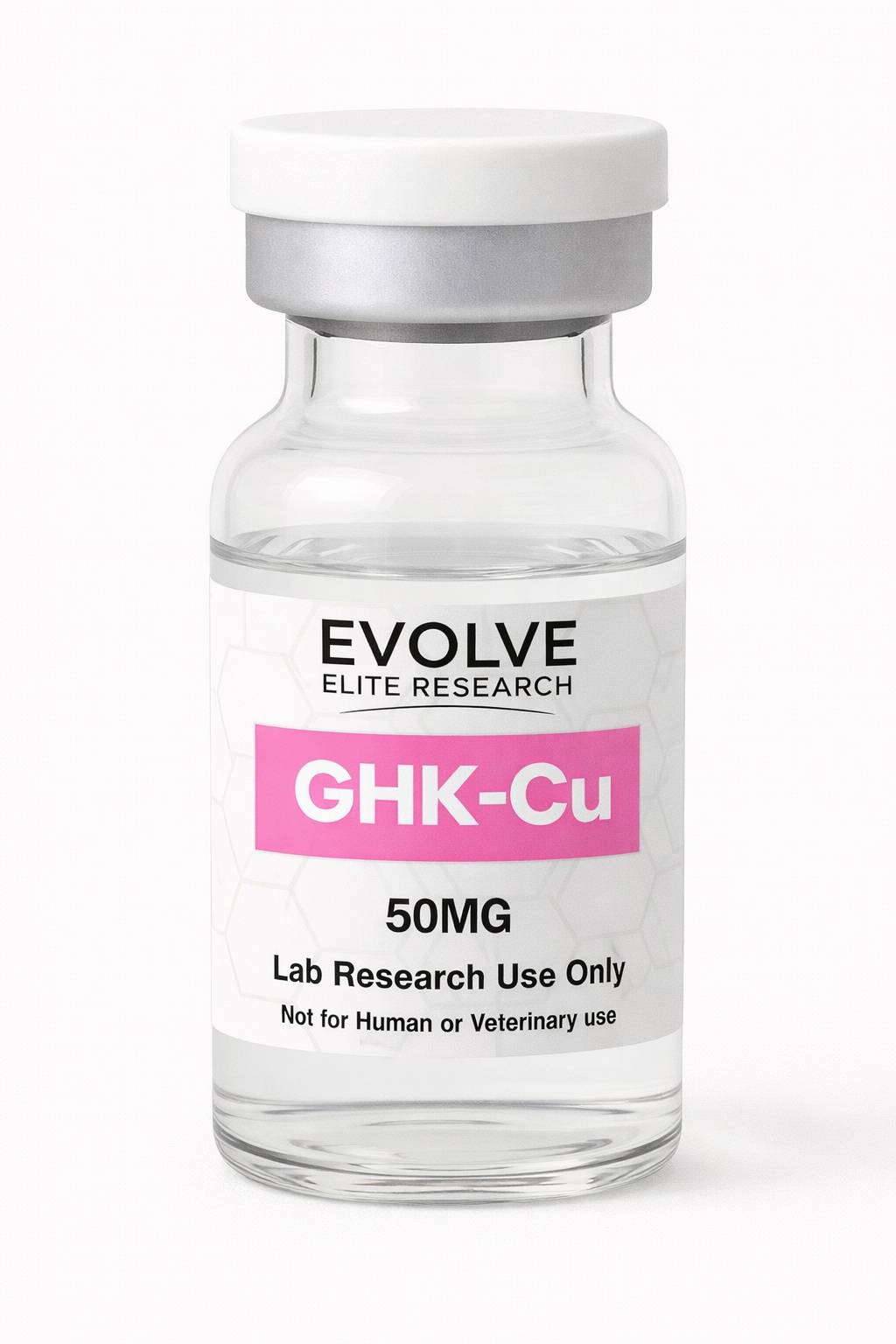
GHK-Cu 50MG
$28.00
GHK-Cu 50MG is a Copper Tripeptide-1 research compound containing the copper-associated tripeptide Gly-His-Lys (Cu-GHK), supplied exclusively for laboratory research.
Technical Specifications
- Product Name: GHK-Cu 50MG
- Scientific Name: Copper Glycyl-L-Histidyl-L-Lysine
- Common Name: Copper Tripeptide-1
- Alternative Name: Cu-GHK
- Peptide Sequence: Gly-His-Lys
- Reference Formula: C14H24CuN6O4
- Reference Molecular Weight: 403.92 g/mol
- PubChem CID: 378611
- Physical Form: Blue lyophilized research material
- Research Quantity: 50MG
- Intended Use: Laboratory research only
In stock
🔬 For Laboratory Research Use Only.
Not for human consumption, medical, veterinary, or household use.
By purchasing you agree to our
Terms and
Refund Policy.
GHK copper complex for controlled laboratory research
Gly-His-Lys peptide sequence with copper coordination
Applicable to peptide identity, copper coordination and stability studies
Prepared and shipped from our Texas facility
Copper-associated glycyl-L-histidyl-L-lysine supplied exclusively as a laboratory research material for investigations involving peptide-metal coordination, molecular characterization, extracellular-matrix models and related biochemical research.
GHK-Cu Research Summary
GHK-Cu is a copper-associated complex of the naturally occurring tripeptide glycyl-L-histidyl-L-lysine, commonly abbreviated GHK. The peptide contains three amino-acid residues arranged in the sequence Gly-His-Lys.
The copper-coordinated form may also appear in scientific and technical literature as Cu-GHK or Copper Tripeptide-1. Copper coordination distinguishes GHK-Cu from the uncomplexed GHK peptide and affects molecular mass, charge distribution, optical characteristics and analytical behavior.
GHK and GHK-Cu have been investigated across biochemical, cell-based and preclinical experimental systems. Published research includes studies involving copper coordination, fibroblast models, extracellular-matrix regulation, collagen-associated measurements, proteoglycans, matrix metalloproteinases and related molecular pathways.
Findings involving GHK-Cu depend on the experimental model, molecular form, concentration, exposure conditions and analytical methods used. Cell-based or preclinical observations should not be interpreted as establishing safety, effectiveness or clinical outcomes in humans.
Technical Specifications
GHK-Cu 50MG
Copper Glycyl-L-Histidyl-L-Lysine
Copper Tripeptide-1
Cu-GHK
Glycyl-L-Histidyl-L-Lysine
Gly-His-Lys
3 amino-acid residues
Copper-binding linear tripeptide
Copper
C14H24CuN6O4
Approximately 403.92 g/mol
378611
Lyophilized research material
50MG labeled quantity
See applicable Certificate of Analysis
Laboratory research only
GHK-Cu may be represented using different coordination states, protonation states, counterions or hydration states. Molecular calculations should correspond to the specific reference structure and analytical documentation applicable to the research material.
What Is GHK-Cu?
GHK-Cu combines the tripeptide GHK with copper in a coordination complex. GHK consists of glycine, histidine and lysine, with the histidine-containing region contributing importantly to copper binding.
Coordination with copper changes the chemical environment of the peptide. For analytical purposes, GHK and GHK-Cu should therefore be treated as related but distinct molecular forms rather than interchangeable names for the same test article.
The uncomplexed Gly-His-Lys tripeptide.
A copper-associated form of the GHK tripeptide.
A commonly used name for copper-associated GHK.
An alternative abbreviation commonly encountered in scientific literature.
GHK vs. GHK-Cu: What Is the Difference?
GHK and GHK-Cu share the same Gly-His-Lys peptide backbone, but GHK-Cu contains coordinated copper while GHK refers to the metal-free parent peptide.
Copper coordination can alter molecular mass, charge distribution, visible absorbance, chromatographic behavior and mass-spectrometric response. It may also influence experimental behavior in systems containing competing proteins, buffers or other metal-binding ligands.
Experiments intended to distinguish peptide-associated effects from copper-associated effects may compare uncomplexed GHK, GHK-Cu and an appropriate copper-only control under otherwise matched laboratory conditions.
GHK and GHK-Cu should not be assumed to produce identical analytical or experimental behavior simply because they contain the same three-amino-acid peptide sequence.
Why Is Copper Important in GHK-Cu Research?
GHK contains functional groups capable of participating in copper coordination. Formation and stability of a copper-peptide complex can depend on variables including pH, ligand-to-metal ratio, buffer composition, ionic strength and the presence of competing ligands.
This chemistry matters because copper coordination can affect how the material behaves during chromatography, spectroscopy, mass spectrometry and other analytical procedures.
Influences the distribution of peptide-associated and unbound copper species.
Can influence protonation and copper-coordination behavior.
Some buffer components may interact with copper or affect complex stability.
Other metal-binding molecules may alter copper association with GHK.
What Has GHK-Cu Been Studied For?
Published GHK-Cu research spans several experimental areas. The evidence is not uniform across these areas, and individual findings should be interpreted according to the type of model used.
Characterization of peptide-metal association, molecular form and copper-dependent analytical behavior.
Cell-culture studies have examined fibroblast responses and extracellular-matrix-associated measurements.
Published laboratory studies have evaluated collagen synthesis and related matrix measurements in defined experimental models.
Research has examined matrix metalloproteinases, proteoglycans and glycosaminoglycan-associated endpoints.
HPLC, mass spectrometry, spectroscopy and copper-content measurements may be used to investigate different properties of GHK-Cu.
Experimental work may evaluate how environmental and solution conditions affect peptide integrity and copper association.
GHK-Cu and Collagen Research
GHK-Cu has been investigated in laboratory models involving collagen and extracellular-matrix biology. An early fibroblast-culture study evaluated collagen synthesis in the presence of the copper-tripeptide complex, while later studies examined additional matrix-related endpoints.
Other published experimental work has evaluated GHK-Cu in relation to MMP-2, glycosaminoglycans and proteoglycans such as decorin. These studies represent different experimental systems and should not be combined into a single generalized biological claim.
Changes measured in cultured cells or preclinical models do not by themselves demonstrate a corresponding effect, safety profile or clinical outcome in humans.
Analytical Characterization of GHK-Cu
GHK-Cu is a metal-peptide complex, making it useful to distinguish several analytical properties rather than relying on one measurement alone.
Provides chromatographic information regarding detectable molecular components under a defined method.
Supports evaluation of molecular identity and detected mass-to-charge species.
May be used to investigate optical characteristics associated with copper coordination.
Measures copper content but does not independently establish its coordination state.
HPLC peak-area purity, peptide identity, peptide content, copper content, coordination state and labeled vial quantity are separate analytical characteristics. One measurement should not automatically be substituted for another.
Why Is GHK-Cu Blue?
The characteristic blue appearance associated with GHK-Cu reflects electronic properties of copper within its coordination environment.
Color intensity can vary with concentration, pH, path length and molecular environment. Visual appearance alone does not establish molecular identity, chromatographic purity, concentration or copper-to-peptide stoichiometry.
GHK-Cu Stability and Laboratory Storage
Stability of GHK-Cu research material may be influenced by temperature, moisture, light, oxygen, pH, buffer composition and competing metal-binding ligands.
Lyophilized material should be maintained according to the applicable product label, lot documentation and validated laboratory procedures. Excessive heat, light, moisture and repeated temperature cycling should be minimized.
Solution-phase behavior may differ from that of dry lyophilized material because peptide degradation, surface adsorption and metal exchange can become more relevant after preparation in a laboratory medium.
Storage information on this page concerns preservation and characterization of research material. It is not an administration, dosing, cosmetic-preparation or human-use protocol.
Laboratory Handling Considerations
GHK-Cu should be handled by qualified research personnel using laboratory procedures appropriate for peptide and metal-containing research materials.
Experimental documentation may include lot identity, preparation conditions, concentration calculations, buffer composition, storage conditions and analytical observations relevant to the research protocol.
Laboratory safety procedures, personal protective equipment and disposal practices should follow applicable institutional requirements and the laboratory’s own risk assessment.
Related Research Compounds
GHK-Cu Scientific Research Resources
Frequently Asked Questions About GHK-Cu
What is GHK-Cu?
GHK-Cu is a copper-associated complex of the tripeptide glycyl-L-histidyl-L-lysine, commonly abbreviated GHK.
What does GHK stand for?
GHK represents the three amino-acid residues glycine, histidine and lysine, arranged in the sequence Gly-His-Lys.
Is GHK-Cu the same as Copper Tripeptide-1?
Copper Tripeptide-1 is a commonly used name for a copper-associated form of the GHK tripeptide.
What is the difference between GHK and GHK-Cu?
GHK refers to the metal-free Gly-His-Lys peptide, while GHK-Cu contains copper coordinated with the peptide. Copper coordination changes several molecular and analytical properties.
Why is copper important in GHK-Cu?
Copper forms a coordination complex with GHK and changes the peptide’s chemical and analytical behavior. The resulting complex can differ from uncomplexed GHK in mass, charge, spectroscopy and chromatography.
What has GHK-Cu been studied for?
Published experimental research includes copper coordination, fibroblast models, collagen-associated measurements, extracellular-matrix regulation, proteoglycans, matrix metalloproteinases and analytical characterization.
What does research show about GHK-Cu and collagen?
Published cell-culture research has examined collagen synthesis in fibroblast systems exposed to GHK-Cu. These findings are specific to the experimental models used and should not be interpreted as establishing human clinical outcomes.
Why is GHK-Cu blue?
The characteristic blue appearance is associated with the electronic properties of copper in the peptide coordination environment. Color alone does not confirm identity, purity or concentration.
What analytical methods can be used to study GHK-Cu?
Depending on the research objective, methods may include HPLC, LC-MS, ultraviolet-visible spectroscopy and copper-content analysis.
Can HPLC alone confirm GHK-Cu identity?
No. HPLC provides chromatographic information, but additional analytical methods may be required to evaluate molecular identity, copper content or coordination state.
What factors can affect GHK-Cu stability?
Variables may include temperature, moisture, light, oxygen, pH, buffer composition and competing metal-binding ligands.
Where can lot-specific analytical information be reviewed?
Lot-associated analytical information should be reviewed through the applicable Certificate of Analysis when available.
Is GHK-Cu 50MG intended for human use?
No. This product is supplied strictly as a laboratory research material and is not intended for human consumption or administration.
Is this GHK-Cu product intended for cosmetic use?
No. This product is supplied exclusively for laboratory research and is not intended for cosmetic application or personal use.
Research Use Only
This material is not intended for human consumption, human administration, veterinary use, clinical use, diagnostic use, cosmetic application, compounding, food use, household use or administration of any kind.
Information presented on this page is provided solely for scientific and educational reference regarding the identity, chemistry, analytical characteristics and published experimental investigation of GHK-Cu.
References to published research describe experimental observations within the specific models and conditions reported by the cited investigators. They are not representations of safety, effectiveness, therapeutic benefit or suitability for any human or veterinary purpose.
Nothing on this page constitutes medical advice, prescribing information, dosing information, instructions for administration or instructions for cosmetic or personal use.
Purchasers are responsible for ensuring that acquisition, possession, storage, handling, experimentation and disposal comply with applicable laws, institutional policies and laboratory safety requirements.
Related products
Research Compounds
Research Compounds
Research Compounds
Research Compounds
Research Compounds
Research Compounds
Research Compounds
Research Compounds